Input, decision-making, output, feedback
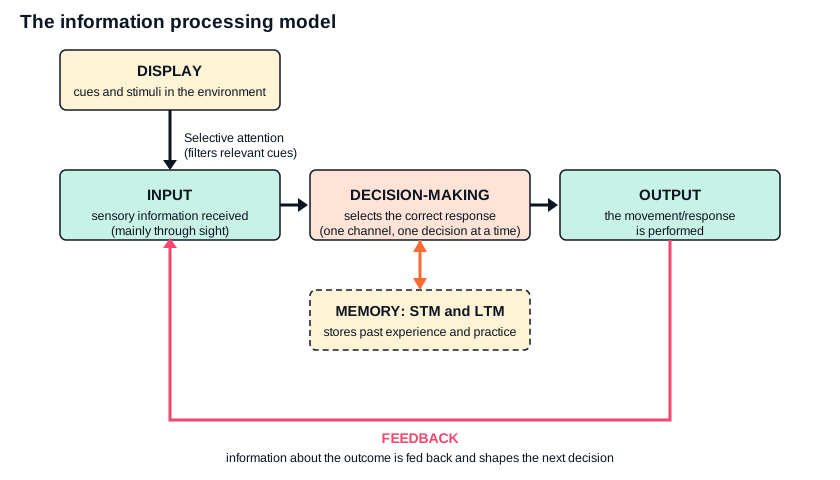
A performer processes information through four linked stages in a loop. Input -- sensory information is received, mainly through sight, with selective attention filtering out irrelevant cues. Decision-making -- the correct response is chosen, using the input plus memory. Output -- the response is carried out as a movement. Feedback -- information about the outcome or quality is used for the next decision, so one action's feedback becomes the next input.
STM vs LTM: temporary vs permanent stores
Two memory stores support decision-making. Short-term memory (STM) holds a small amount of information for a few seconds, for an immediate decision such as reading a defender's position; unrehearsed information is quickly lost. Long-term memory (LTM) is a permanent store of an unlimited amount, built through practice, such as a set play. Information is recalled from LTM into STM to decide faster. STM is temporary and immediate, whereas LTM is permanent and practised.
Single-channel hypothesis
The brain has a limited channel capacity: information passes through a single channel, one piece at a time -- the single-channel hypothesis. Facing many stimuli at once (crowd, team-mates, the ball) risks information overload, slowing the decision or causing a wrong one. Selective attention filters out irrelevant stimuli and focuses on the most important cue. Experienced performers do this better because long-term memory tells them which cues matter.
Drawn from real examiner reports.
Input & feedback answered generically
Candidates are strong on decision-making and output but answer input and feedback too generically. A weak input answer says "gets information" without the HOW -- which sense (sight) and which cue. A weak feedback answer says "gets feedback" without saying how it changes the next attempt. Name the cue for input and the adjustment for feedback.
Input/feedback stages answered generically (s23 P11 Q13a; s23 P13 Q6b(i); w23 P13 Q5)
STM vs LTM stated one-sidedly
Asked for a difference between STM and LTM, candidates often make a standalone statement about only one store (usually STM) instead of a comparison. A genuine comparison puts both sides together -- duration, amount, and how each is built -- ideally with a contrast word like "whereas". Two unconnected statements are not a comparison and cap the mark.
STM/LTM given one-sidedly, not as a difference (s22 P12 Q12b; s22 P13 Q2b; s23 P11 Q13b; s23 P12 Q12c)
Feedback vs guidance vs motivation
Feedback is often confused with guidance or motivation. Feedback is information about the outcome or quality of an attempt just carried out. Guidance is help given to aid learning, before or during the action. Motivation is the drive to succeed. Confusing them makes a "feedback" answer describe coaching advice, not information about a completed attempt.
Feedback confused with guidance/motivation (s22 P12 Q12b; s22 P13 Q2b; s23 P11 Q13b; s23 P12 Q12c)
Decision-making is not output
Decision-making and output are different stages. Decision-making is choosing the response, using the input and memory -- it happens in the brain, before movement. Output is carrying out that response as a physical movement. A common slip is describing the performer "doing" the skill at the decision-making stage, or merging the two. Decide first, then output.
Dropping or reordering the stages
Asked to name the four stages, candidates drop one (usually feedback) or give them out of order. The sequence is fixed: input, decision-making, output, feedback -- and feedback then loops back to inform the next input. Leaving feedback out breaks the loop, so the model no longer explains how performance improves attempt by attempt. Learn all four, in order, as a cycle.
Selective attention is not ignoring all cues
Selective attention does not mean blocking out everything except one fixed cue. It means filtering out irrelevant stimuli (crowd, unrelated players) while focusing the channel on the most important cue at that instant -- and switching cue as the situation changes. Treating it as permanent tunnel vision, or ignoring the whole environment, misdescribes it.
You cannot process two cues at once
Students assume a skilled performer attends to several stimuli at once. The single-channel hypothesis says only one piece of information is processed at a time. The performer is not working in parallel but using selective attention, switching between cues so fast it feels simultaneous. Too many competing cues overload the channel, so the decision slows or goes wrong.
Apply every stage to the named activity
Apply every stage to the named activity: input = the sense (sight) and cue; decision-making = what is decided; output = the movement; feedback = what is noticed and how the next attempt changes. A generic answer not tied to the sport loses the most marks.
Use "whereas" for STM vs LTM comparisons
For a "difference between STM and LTM", join both stores with "whereas" or "while": "STM holds a small amount for seconds, whereas LTM stores an unlimited amount permanently." This forces a real comparison, not two unconnected statements.
Match the command word
Match the command word. "State" wants the term only; "describe" wants what the stage does; "explain/apply" wants the stage plus why it matters, tied to the activity. Explain answers too often stay descriptive -- add the reasoning the command demands.
A performer can be thought of as processing information through four linked stages, in a loop.
Full notes, flashcards, Q&A and the topic quiz for every premium subject.
Premium plans are US$8.99/month or US$49.99/year — first month free.
Studying with a parent's blessing? Show them this.
