Health (WHO) — three dimensions
The WHO defines health in two mark-bearing parts. Positively, it is complete physical, mental and social well-being: physical = the body's systems working, free from injury or illness; mental = coping with everyday stress and low anxiety; social = good relationships and a sense of belonging. It is also NOT merely the absence of disease or infirmity — someone with no illness can still be unhealthy through stress or isolation.
Fitness and its link to health
Fitness is the ability to cope with, or meet the demands of, the environment. Health and fitness are linked but not identical. Ill health lowers fitness: illness or injury reduces how well the body meets demands, so fitness falls while recovering. Yet a performer can be unhealthy and still fit enough to train — well-controlled mild asthma need not stop hard training. Conversely, a very fit but highly stressed or isolated athlete still has poor mental or social health.
Healthy, active lifestyle — three parts
Three interdependent elements support long-term health, and examiners credit all three: regular physical activity (often and hard enough to stress the body's systems), a balanced diet (the right amount and balance of nutrients), and maintaining fitness to meet the demands of daily life and sport. Missing any one undermines the others — a performer who trains hard but eats poorly lacks the nutrients to recover and adapt, so gains far less from training.
Drawn from real examiner reports.
Relationship ≠ two definitions
A relationship question wants an explicit link, not two separate definitions. Defining each separately earns little — it never says HOW one affects the other. Name the mechanism: a chest infection lowers a runner's fitness because the body cannot meet training demands while unwell. Even when they link the two, candidates often leave vague which demand cannot be met, and why.
Digest (### 2.1): relationship answers define both terms separately without relating them, and how ill health affects fitness is often only partially developed (s22 P12 Q14a; w23 P11 Q2c).
"Damages health" is too vague
Lifestyle-choice and health-effect answers need a specific, developed consequence, not a general "it is bad for you". "Smoking can damage health" is too vague — it never says what the damage is; the credit-worthy version is "smoking can cause lung cancer". Finish a health-effect sentence with the named outcome, not a bare adjective like "bad" or "unhealthy".
Digest (### 2.1): lifestyle-choice/health-effect answers need a specific, developed consequence -- "smoking can damage health" is too vague; "smoking can cause lung cancer" is credit-worthy (s22 P12 Q14b).
Health ≠ just "not being ill"
Many define health only as the absence of disease and stop, dropping the positive half of the definition. Both halves score: the positive statement (complete physical, mental and social well-being) AND the rejection (not merely being disease-free). Someone with no illness can still be unhealthy — high stress is poor mental health; isolation, poor social health.
Forgetting the social dimension
Asked for the three dimensions of health, candidates routinely name physical and mental but omit social. Social health — good relationships with family, friends and the wider community, and a sense of belonging — is examined equally with the other two. A vague example such as "being well" is not credited; give a specific one, such as belonging to a sports team or club.
"Exercise is good for you" — too vague
Describing a positive effect of exercise needs a specific mechanism, not a vague adjective. "Exercise is good for you" earns nothing; "regular exercise strengthens the heart muscle, which can lower resting heart rate" does. Name which dimension benefits — physical, mental or social — and state the developed consequence, not a generic "it helps you".
"Healthy" or "fit" left unqualified
Writing that a performer "is healthy" or "is fit" without qualification is repeatedly marked down. For health, say WHICH dimension — physical, mental or social. For fitness, link back to the definition — meeting the demands of WHAT activity — rather than "fit" alone. Precise wording naming the dimension or the demand earns marks that a vague term does not.
Health and fitness are the same thing
Students treat "fit" and "healthy" as interchangeable — assuming fit means healthy, and a condition means unfit. In fact fitness only means meeting the demands of the environment, while health is complete physical, mental AND social well-being. So they diverge: a very fit but stressed athlete has poor mental health, while someone with well-controlled asthma stays fit.
Digest (### 2.1): the recurring error of describing health and fitness as separate, unrelated definitions is the root of this misconception (s22 P12 Q14a; w23 P11 Q2c).
Answer "relationship" with a "because"
When asked for a relationship, do not just define the two terms — state the link explicitly with a "because" clause: "ill health lowers fitness because the body cannot meet the demands of training while unwell." An explicit causal link lifts the answer out of the lowest band.
Name the dimension; give a specific effect
For effects-of-exercise questions, always name which dimension benefits — physical, mental or social — and give a specific, developed consequence rather than a vague adjective. "Improves mental health by reducing stress and anxiety" scores; "makes you feel better" does not.
Apply to a named performer
The most repeated criticism across every sitting is a generic answer instead of one linked to the named sport or performer. Rather than a claim about "exercise", say what happens for a named netball player, footballer or swimmer, and keep referring back to them.
Health (World Health Organization definition) -- a state of complete physical, mental and social well-being, not merely the absence of disease or infirmity.
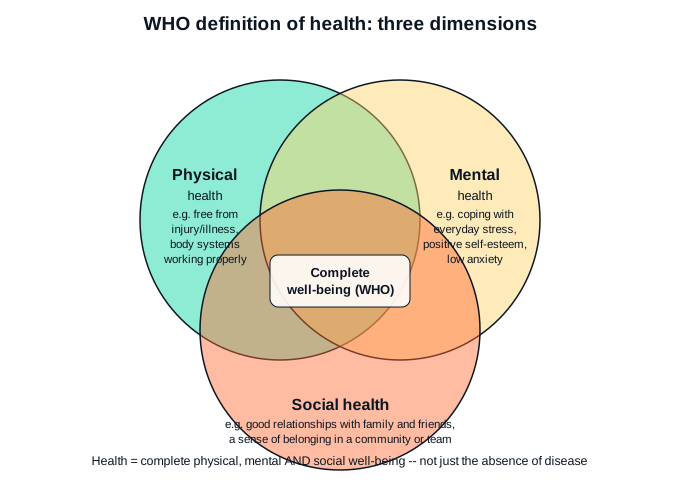
The three dimensions overlap -- being healthy needs all three, not just one.
Full notes, flashcards, Q&A and the topic quiz for every premium subject.
Premium plans are US$8.99/month or US$49.99/year — first month free.
Studying with a parent's blessing? Show them this.
