Air pathway: mouth to alveoli
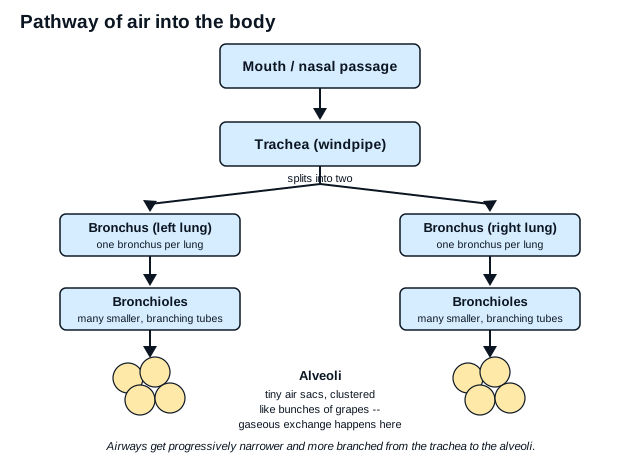
Air follows a fixed, one-way route that narrows and branches at each stage: mouth or nasal passage, then the trachea (one wide windpipe), which splits into two bronchi (one per lung). Inside the lungs these divide repeatedly into many narrow bronchioles, each ending in a cluster of tiny air sacs, the alveoli, where gaseous exchange happens. Learn the five structures in order; how the air is moved is breathing mechanics (1.6), not this topic.
Alveoli: four adaptations for gas exchange
Four features make the alveoli efficient at gaseous exchange, each worth its own mark. Large surface area -- millions of alveoli let a large volume of gas cross at once. Wall one cell thick -- a short diffusion distance. Moist lining -- gases dissolve before crossing. Dense capillary network -- a constant fresh blood supply keeping the concentration gradient steep. Name each feature with its precise term AND its effect, not just "good for gas exchange".
Gaseous exchange: diffusion and direction
Gaseous exchange is diffusion -- passive movement of a gas from high to low concentration. The two gases move in opposite directions, each down its own gradient. Oxygen is more concentrated in the alveolar air than in the blood, so it diffuses into the blood; carbon dioxide is more concentrated in the blood, so it diffuses out of the blood. Getting each gas and its direction right is the key exam detail.
Drawn from real examiner reports.
"Thin" is not "one cell thick"
Examiners credit the precise term, not a vague approximation. "Thin" scores nothing for the wall -- the mark-scheme detail is "one cell thick", which gives the short diffusion distance. The same trap catches "efficient" instead of "large surface area", and "wet" instead of "moist lining". Pair each feature with its exact term.
s22 P12 Q9a; s22 P13 Q14a; w22 P11 Q4b; w23 P13 Q9b
Undirected gas-movement statements
Description and diagram questions need directional precision. "Gases move between the blood and the alveolus" earns nothing -- it never says which gas goes which way. On arrow diagrams candidates draw the arrow the wrong way or add contradictory arrows. Always give the gas AND its direction: oxygen diffuses into the blood, carbon dioxide out of it.
w22 P11 Q4a; w23 P13 Q14a
Trachea vs bronchi vs bronchioles
These airway structures are easily muddled or listed out of order. The trachea is one wide windpipe; it splits into two bronchi, one per lung; the bronchi branch into many narrow bronchioles ending at the alveoli. Number and width both change down the tree. Give them in order; do not jump from trachea straight to alveoli.
Naming a feature without its effect
On an "explain" question, listing the alveolar features alone caps the marks -- each must be linked to why it speeds diffusion. "One cell thick" needs "so the diffusion distance is short"; "large surface area" needs "so more gas diffuses at once"; "moist lining" needs "so gases dissolve first". Feature plus effect is what "explain" demands.
Repeating the question stem
If the stem already states the alveolus is a gas-exchange surface, or already names a structure, repeating that fact earns nothing. Marks come from the detail you ADD -- the precise term, the direction of each gas, or the effect of a feature. Answer only the part the question is actually asking, rather than restating the stem.
Gas exchange is not breathing
Gaseous exchange is the diffusion of gases across the alveolar wall; it is not breathing, the mechanical movement of air in and out of the lungs (topic 1.6). A gas-exchange question wants oxygen and carbon dioxide moving between alveolus and blood, not a description of the diaphragm and ribs. Answer the process being asked.
Both gases diffuse the same way
Because both gases are "exchanged", students assume they travel the same way -- e.g. carbon dioxide diffusing in alongside oxygen. In fact each gas moves independently down its own gradient, and the gradients point opposite ways: oxygen is higher in the alveolar air so it diffuses IN; carbon dioxide is higher in the blood so it diffuses OUT.
w22 P11 Q4a; w23 P13 Q14a
Match the command word
Match the answer to the command word. "State/name" wants the term only ("large surface area"). "Describe" wants the feature plus brief detail. "Explain" wants the feature AND its effect on diffusion. Read the command word first so you neither under- nor over-answer.
Bank the four precise terms
Learn the four precise terms and use them exactly: "one cell thick" (not "thin"), "large surface area" (not "efficient"), "moist lining" (not "wet"), "dense capillary network" (not "lots of blood"). A vague synonym is not credited -- the exact wording is what earns the mark.
Name both the gas and its direction
When describing gaseous exchange, name BOTH the gas and its direction: oxygen moves INTO the blood, carbon dioxide OUT OF it. A combined phrase like "gases are exchanged", or an undirected arrow, loses the mark. State each gas and its own direction every time.
Apply the answer to the named activity
When the question names a sport or performer, apply your answer to them: the large surface area and short diffusion distance let a distance runner take in oxygen fast enough for the working muscles. A generic answer with no named activity is capped below full marks.
Full notes, flashcards, Q&A and the topic quiz for every premium subject.
Premium plans are US$8.99/month or US$49.99/year — first month free.
Studying with a parent's blessing? Show them this.
