Universe → galaxy → Solar System
Three scales. Solar System: the Sun (one star) plus its 8 planets, moons, asteroids, dwarf planets and comets. Galaxy: a large collection of billions of stars held by gravity — ours is the Milky Way. Universe: a large collection of billions of galaxies. Precision: the Universe holds galaxies (not stars); a galaxy holds stars (not planets); list bodies by category, not by naming planets again.
Redshift is evidence for the Big Bang
Redshift: light from a receding galaxy has a longer wavelength (shifted toward red); faster recession → greater redshift. Big Bang chain: (1) distant galaxies are redshifted → (2) they are moving away → (3) more distant ones recede faster (Hubble: ) → (4) in the past everything was closer together → (5) the Big Bang. CMBR is a second line: microwave radiation from all directions, formed shortly after the Big Bang.
Stellar evolution: two mass paths
Both paths: nebula (gas/dust) contracts under gravity → protostar (hot, dense core) → nuclear fusion of hydrogen begins → outward radiation pressure balances gravity → main sequence star. Low mass (like the Sun): main sequence → red giant → white dwarf → black dwarf. High mass: main sequence → red supergiant → supernova → neutron star or black hole. Gravity drives the collapse and holds the star together.
Drawn from real examiner reports.
A light-year is distance, not time
A light-year is a unit of distance, not time: "the time for light to cross the galaxy" scores zero. The two elements are (1) distance and (2) travelled by light in one year. Value: m — and the unit is metres, not km (a common MCQ trap: right number, wrong unit).
June 2024 P32 Q11(b): "most common error was to refer to a light-year as a unit of time" — reported across P32 and P33; P23 Q40: "most thought the unit was km instead of m".
Surface g depends on planet mass
A planet's surface gravitational field strength depends on the planet's own mass (and radius), NOT its distance from the Sun. "Mars has weaker gravity because it is further from the Sun" is wrong. Earth has more mass than Venus, so Earth's surface ( N/kg) exceeds Venus's ( N/kg). Definition: , unit N/kg.
June 2024 P32 Q11(a)(i): the primary error was candidates trying to link g to distance from the Sun rather than to the planet mass.
Redshift is not the Doppler effect
When asked what redshift is, "the Doppler effect" is the common wrong answer and earns no credit. Redshift is the increase in the observed wavelength of light from a galaxy moving away from us (spectral lines shifted toward the red end). The Doppler effect is the underlying mechanism, but naming it alone does not define redshift.
June 2024 P43 Q11(a): "the most frequent incorrect response was Doppler effect" — naming the Doppler effect alone is not creditworthy for redshift.
Universe = galaxies, galaxy = stars
Keep the hierarchy straight: the Universe is billions of galaxies; a galaxy is billions of stars; the Solar System is one star (the Sun) with its planets. Writing "the Universe is billions of stars" describes a galaxy. Many candidates cannot distinguish the Universe from a galaxy — name the correct level for every mark.
June 2024 P33 Q11(b): "many candidates did not correctly distinguish between the Universe and galaxies."
Convert days to seconds first
In (and light-travel sums), the period must be in seconds. Convert days to seconds first: multiply by . Leaving in days (e.g. using 365 days directly) gives an answer out by a factor of 86 400. Always convert time to SI units before substituting, and quote the unit.
June 2024 P22 Q38: "weaker candidates often incorrectly chose option C as they did not convert 365 days into seconds."
CMBR formed shortly after the Big Bang
CMBR formed shortly after the Big Bang (when the Universe first became transparent), not "at the Big Bang". An answer that just says "Big Bang" with no reference to time is not creditworthy. As the Universe expanded, this radiation was redshifted from high energy to the microwave region, and it now arrives from all directions.
June 2024 P33 Q11(c)(i): answers "just stating Big Bang without reference to time were not creditworthy"; CMBR formed shortly after the Big Bang.
Big Bang evidence: give the full chain
For "evidence for the Big Bang", give the whole chain: redshift observed → galaxies receding → more distant recede faster (Universe expanding) → in the past they were closer together → Big Bang. Naming redshift alone scores 1 mark; each linked step is a mark.
Space sums: convert units, keep s⁻¹
For space calculations: convert time to seconds first, then substitute. Quote the unit — the Hubble constant is in s⁻¹ and is often dropped. Check whether a light journey is one-way or there and back before using .
Name the object, avoid it and they
Name the object explicitly — write "the light from the galaxy" and "the galaxies", not "it" and "they". Examiners note that vague pronouns make Big Bang answers unclear and lose marks. Restate the subject at each step so the marker can follow which object moves.
Match the star path to its mass
Match the star's fate to its mass: low-mass → red giant → white dwarf; high-mass → red supergiant → supernova → neutron star or black hole. Don't use "giant" for both paths or omit the supernova stage. Spell nuclear fusion clearly — "fission" loses the mark.
Hierarchy (largest → smallest): Universe → Galaxy → Solar System → Planet → Moon.
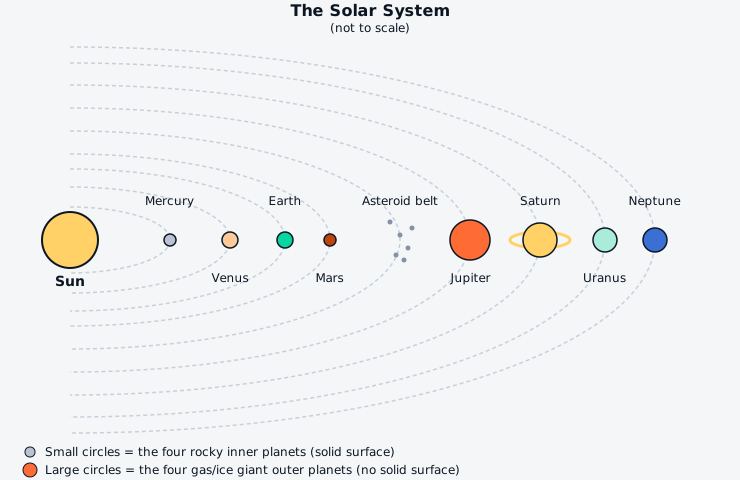 The eight planets in orbital order: small rocky inner planets, then large gas and ice giant outer planets.
(E) Define a galaxy.
(E) The nearest star to the Sun is Proxima Centauri, which is 4.24 light-years away.
One light-year m.
Calculate the distance from the Sun to Proxima Centauri in metres. (2 marks)
