α, β, γ: charge, penetration, ionising
Alpha (α): a helium-4 nucleus (), charge +2; stopped by paper; most ionising, least penetrating. Beta-minus (β⁻): a fast electron, charge −1; stopped by ~3 mm aluminium; medium ionising. Gamma (γ): EM radiation, no charge, no mass; only reduced by thick lead or concrete; least ionising, most penetrating. Ionising and penetrating power are inversely related. PAL: Paper / Aluminium / Lead stop α / β / γ.
Half-life: half the nuclei decay
Half-life (): the time for half the radioactive nuclei in a sample to decay (so the activity falls to half). Both elements are needed — the word "nuclei" is required. Integer calculation: count the halvings. with . Example: 6400 Bq, min; after 9 min, , so . Activity is in becquerels (Bq): 1 Bq = 1 decay per second.
Nuclear equations: balance A and Z
Both the nucleon number (top) and the proton number (bottom) balance across the arrow. Alpha decay: , , e.g. . Beta-minus decay: unchanged, (a neutron becomes a proton), e.g. — this changes the element. Gamma emission: no change in or , only energy released.
Drawn from real examiner reports.
Alpha decay: A − 4, Z − 2
For alpha decay, falls by 4 and falls by 2 — the alpha particle is (4 on top, 2 below), not the reverse. Do not write "A − 2, Z − 4". An alpha particle is a helium-4 nucleus, not a helium atom (it has no electrons). June 2024 examiner report: candidates guessed alpha-decay facts, spreading answers across all options.
June 2024 Paper 11 MCQ Q34: "poor knowledge with strong evidence of guesswork as answers were spread across all four options almost equally" — alpha decay facts are a perennial weak spot on Core MCQ papers.
PAL: paper, aluminium, lead
Match the shield to the radiation: paper/skin stops α, ~3 mm aluminium stops β, thick lead or concrete reduces γ. Do not pick aluminium for α or lead for β. And γ is attenuated (reduced), never fully stopped — "lead stops gamma" scores zero; write "lead reduces/attenuates gamma". Candidates often misapply gamma shielding to alpha.
June 2024 Paper 11 Q36 and Paper 22 Q36: both report confusion between aluminium and lead for shielding, and between alpha and beta suitability for thickness gauging — in the same sitting across multiple papers.
Half-life must name the nuclei
Half-life is "the time for half the radioactive nuclei to decay", not "the time for the activity/count/radiation to halve". Omitting "nuclei" loses a mark. "Radiation halves" is wrong — the nuclei decay; "atoms decay" is imprecise — say nuclei. Learn the exact wording and don't paraphrase. Half-life is fixed for an isotope, whatever the number of nuclei left.
Cambridge 0625 June 2024 Paper 33 Q10 and general pattern: half-life definition precision is one of the most frequently penalised points in the nuclear physics topic across recent Core P3 sittings.
Correct the count for background
Correct count rates for background radiation first: subtract the background count rate from the detector reading to get the count rate due to the source. A common slip is to subtract the background at the start but forget it applies to every reading — add it back where needed. Always give the unit (counts/s or Bq). Uncorrected counts give the wrong half-life.
June 2024 Paper 12 Q36: "weaker candidates either worked out a count rate without corrections for background radiation, or forgot to add the background count rate back on after 68 hours."
Beta is an electron
A beta-minus particle is an electron — "negative charge" is not enough for the mark. It is a fast electron emitted when a neutron becomes a proton. Because increases by 1, beta decay changes the atom into a different element; many candidates miss this. Do not confuse the particle's identity (electron) with its charge (−1).
June 2024 Paper 33 Q10(c)(i): "only a few candidates knew that beta particles are electrons; a common answer was negative charge." Nov 2023 P32/33 Q36: candidates unaware that beta decay changes the element.
(E) Contamination vs irradiation
Contamination = radioactive material getting onto or into the body; the dose continues after the source is taken away. Irradiation = exposure to an external source; the dose stops once the source is removed or shielded. Alpha is the worst contaminant (very ionising at close range) but a poor irradiator (skin stops it). Do not swap the two terms.
Uses: type → property → application
Answer "uses of radioactivity" as a chain: [type] is used because [property], which means [consequence]. Naming the type alone earns little. E.g. "beta is partly absorbed by aluminium, so a thicker sheet lets fewer beta through".
Half-life from a graph: use a difference
Read a half-life from a decay graph as a time difference: pick any activity, find the time for it to halve, then check with a second point. Don't read from a single point. For integer sums, count how many times the value halves (), then divide or multiply.
Balance A on top, Z on the bottom
Balance every nuclear equation: nucleon numbers (top) add up on both sides, and so do proton numbers (bottom). The beta particle is — its . Read the daughter's symbol from its new ; beta decay gives a new element.
(E) Non-integer half-life formula
For a non-integer number of half-lives use (or the same with activity ). Work out the exponent first, then apply it — do not round to a whole number of half-lives. Keep the unit (Bq or counts/s) on the final answer.
Activity — number of nuclear decays per second, measured in becquerels (Bq); 1 Bq = 1 decay/s.
Half-life () — time for activity (or undecayed nuclei) to fall to half its value; fixed for a given isotope.
| Quantity | Formula | Applies to |
|---|---|---|
| Activity after whole half-lives | , | Core |
| (E) Any elapsed time | Extended |
An isotope starts at 6400 Bq with a 3-minute half-life. Find the activity after 9 minutes.
(Examiner note: always state the unit Bq — omitting it loses the answer mark.)
| Property | Alpha (α) | Beta-minus (β⁻) | Gamma (γ) |
|---|---|---|---|
| Composition | nucleus (2p+2n) | Fast electron | EM radiation |
| Charge | +2 | −1 | 0 |
| Stopped by | Paper / few cm air | ~3 mm aluminium | Reduced by thick lead/concrete |
| Ionising power | Highest | Medium | Lowest |
| Penetrating power | Lowest | Medium | Highest |
| Effect on A | A − 4 | No change | No change |
| Effect on Z | Z − 2 | Z + 1 | No change |
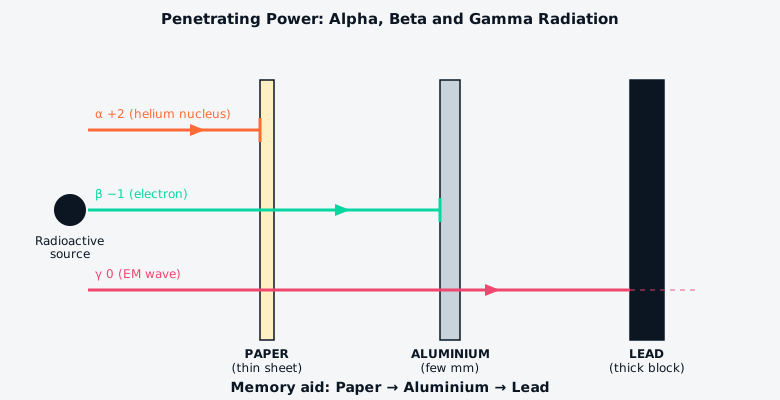
Penetrating power runs opposite to ionising power.
Define alpha (α) radiation.
A Geiger–Müller tube records a count rate of 124 counts per second when placed near a radioactive source. The background count rate, measured separately with no source present, is 4 counts per second.
Calculate the corrected count rate due to the radioactive source alone. State the unit.
