Arrangement, separation and motion
Every particle-description answer needs three separate marks: arrangement, separation and motion. Solid: regular lattice; close, touching; vibrate about fixed positions. Liquid: irregular; close, touching; flow past each other. Gas: random; widely spaced; rapid random motion, changing on every collision. Trap 1: liquid particles are close and touching (like a solid) — "far apart" loses the mark. Trap 2: solid particles vibrate, they are not stationary.
Brownian motion: random zig-zag in a fluid
Brownian motion is the random, erratic (zig-zag) movement of visible particles suspended in a fluid. Two-element definition: (1) random/zig-zag movement of visible particles, (2) suspended in a fluid — "random motion" alone scores 1/2. Explanation: the invisible fluid molecules are small and fast-moving and collide unequally with the larger visible particle, so the net force keeps changing direction. It is evidence that the fluid is made of tiny, fast-moving particles.
Temperature, Kelvin scale, and (E) gas laws
Temperature measures the average kinetic energy of particles (Core) — higher temperature, higher average KE. Internal energy = total KE + PE of all particles, so it also depends on the amount of substance. Kelvin scale: ; 0 K is absolute zero (0 °C = 273 K). (E) Boyle's law (constant temperature) and (constant volume) — always in Kelvin.
Drawn from real examiner reports.
Gas particles: state separation AND motion
On gas-particle questions candidates score the motion mark ("random motion") but miss the separation mark. Both are needed: separation — widely spaced / far apart; motion — move rapidly in random directions. Writing only one scores 1/2. Safe order: write separation first, then motion, so neither is omitted.
June 2024 Paper 31 Q5(a): candidates who structured answers around arrangement/separation/motion scored well; unstructured answers missed the separation mark
Gas pressure: "more frequent" collisions
Explaining raised gas pressure, "more collisions" is insufficient. Core needs "particles collide with the walls more frequently" (the rate rises). (E) Extended also needs "each collision exerts a greater force". The mark-awarding word is "frequently" (or "rate of collisions" / "per second") — practise writing it explicitly.
June 2024 Paper 31 Q5(b)(ii): "more collisions" without "more frequent" was the most common error on gas pressure explanation — key word frequently was rarely seen
Boiling vs evaporating: location, not speed
Comparing boiling and evaporating, the mark-scheme distinctions are location and temperature, not speed. Boiling is throughout the bulk (bubbles inside) and only at the boiling point; evaporating is at the surface only and at any temperature. "Boiling is faster / needs more energy" scores zero. Remember: boiling = bulk, evaporating = surface.
June 2024 Paper 42 Q4(a): weaker candidates listed "surface only" and "no bubbles" as two differences (both cover the same location point); the temperature distinction (boiling point vs any temperature) was the missed second mark
(E) Use Kelvin in gas-law calculations
(E) In (and = constant) the temperature must be in Kelvin, never °C. Convert first: . Substituting Celsius values (e.g. 27 and 127 instead of 300 K and 400 K) gives a completely wrong answer and loses all the marks.
Temperature ≠ internal energy
Temperature is the average kinetic energy per particle; internal energy is the total KE + PE of all the particles, so it also depends on how much substance there is. A large cold lake has more internal energy than a small hot cup of coffee, even though the coffee is at a higher temperature.
Answer particle questions in three parts
For "describe the particles in a [state]" questions, write one sentence each for arrangement, separation and motion, in that order. Structuring the answer this way turns a 1/2 into 2/2, and helps you eliminate MCQ options that miss separation or motion.
(E) Convert to Kelvin before substituting
(E) In any gas-law calculation convert every temperature to Kelvin () before substituting — the most-penalised step. Then write the formula, substitute with units, and give a unit. Shown working earns method marks even if the final value is wrong.
Use precise words: "average", "kinetic"
Cambridge definition marks hinge on exact words. Temperature is the average kinetic energy — dropping "average" or "kinetic" loses marks; gas pressure needs "more frequent collisions"; Brownian motion needs "suspended in a fluid". State both required elements.
Temperature conversion (Core):
= kelvin, = Celsius. Rearranged: .
(E) Boyle's law — constant temperature:
in Pa, in m³ or cm³ (same unit both sides). Temperature must be constant.
(E) Pressure–temperature law — constant volume:
must be in Kelvin — convert before substituting. Using °C is the single most common error on P4 gas-law calculations.
| Feature | Solid | Liquid | Gas |
|---|---|---|---|
| Arrangement | Regular lattice | Irregular, no fixed pattern | Random, no fixed pattern |
| Separation | Very close, touching | Close, touching (like a solid) | Widely spaced, far apart |
| Motion | Vibrate about fixed positions | Flow, move past each other | Rapid random motion; changes on every collision |
| Forces | Strong | Weaker than solid | Negligible |
| Fixed shape? | Yes | No | No |
| Fixed volume? | Yes | Yes | No |
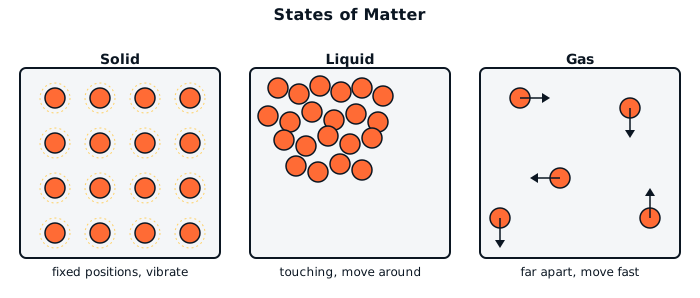 Particle arrangement, separation and motion in solids, liquids and gases.
Define Brownian motion. State what it is evidence for.
A gas is sealed inside a container.
(a) The temperature of the gas is 27 °C. Convert this temperature to kelvin. (1 mark)
(b) The gas is heated. Its temperature is now 327 °C. What is this temperature in kelvin? (1 mark)
(c) A student claims that heating the gas from 27 °C to 327 °C has doubled the temperature. Explain whether the student is correct, using your answers from (a) and (b). (2 marks)
